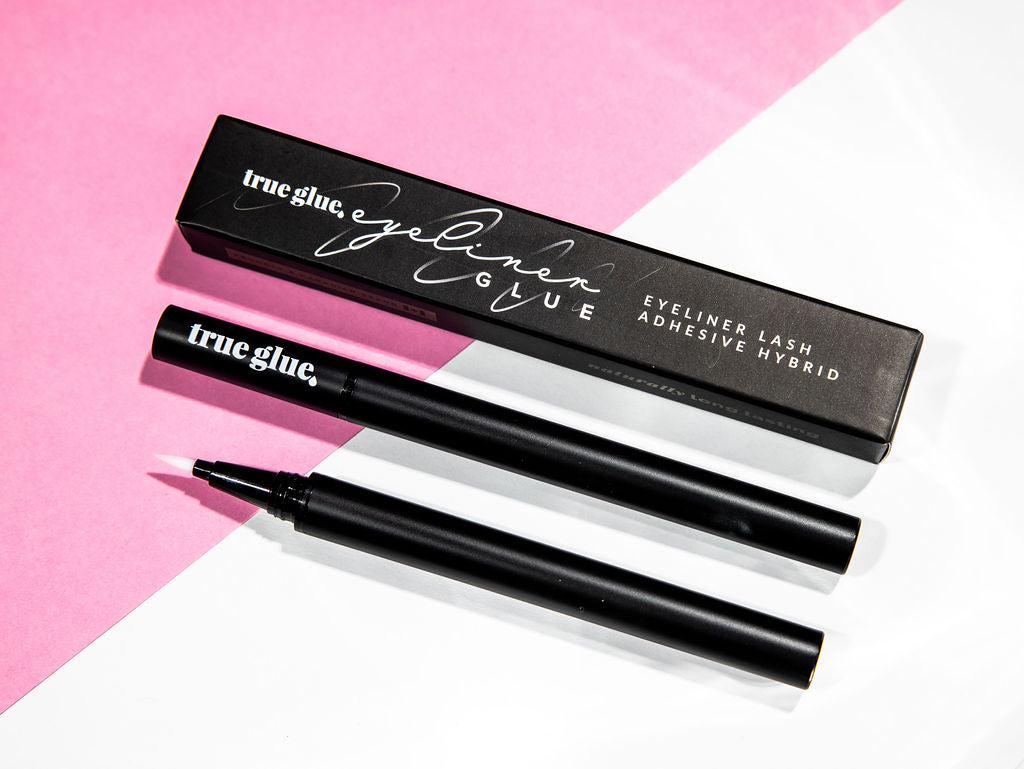
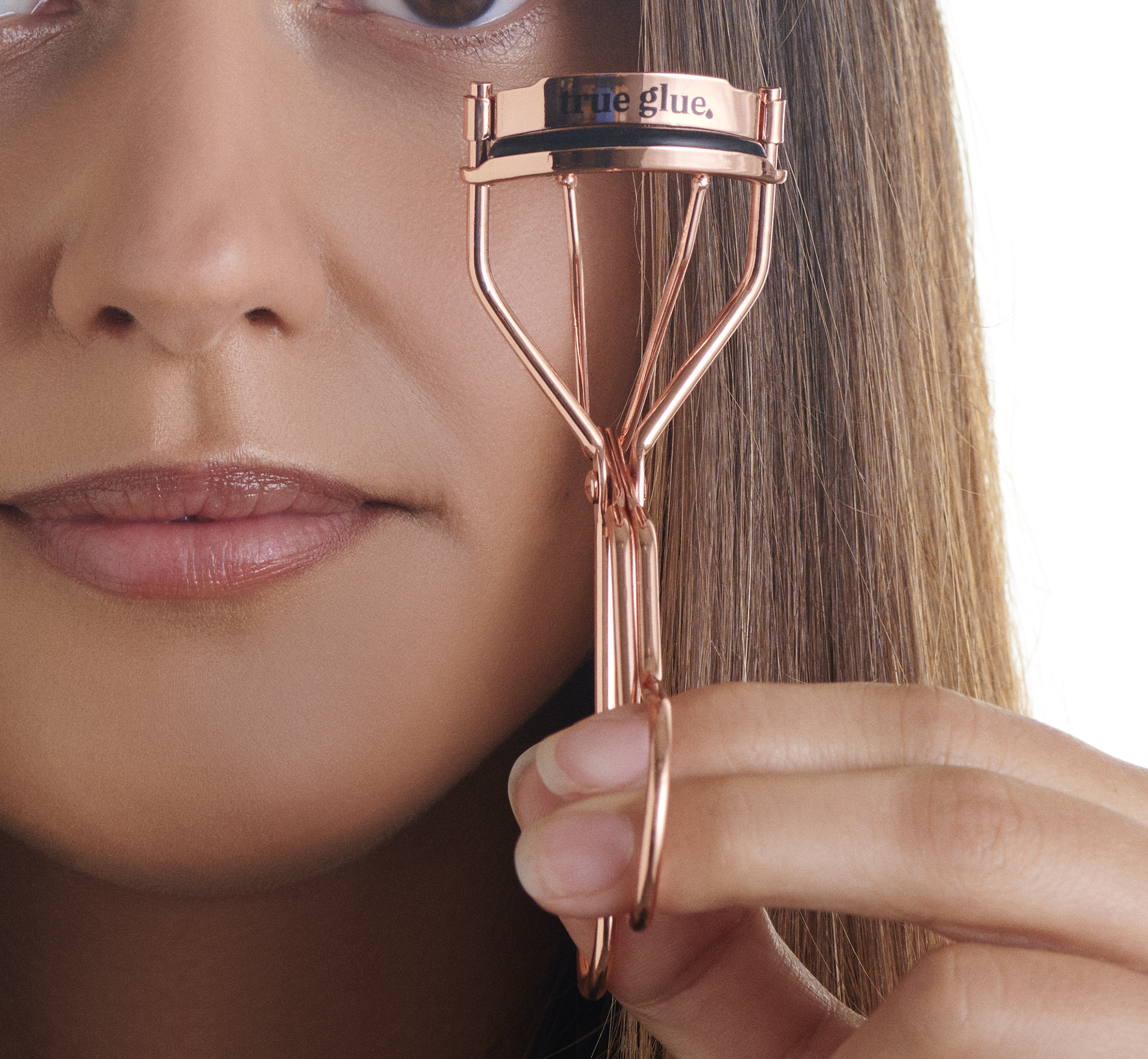
The best strip lash glue for sensitive eyes is latex-free, formaldehyde-free, and fragrance-free, with a clean formulation designed for reactive skin. True Glue Beauty's lash adhesive was built around exactly these criteria, but the broader principle matters more than any single product. The ingredient list is where sensitive-eye safety starts and ends.
Here's what to look for, what to avoid, and how to test before you commit.
Why most strip lash glues irritate sensitive eyes
Conventional strip lash adhesives have two main triggers for sensitive eyes.
Latex. According to the American College of Allergy, Asthma & Immunology, latex allergy affects roughly 1% of the general population, and many more people develop sensitivity to it over time. Latex shows up in most classic black strip lash glues because it gives them their stretchy, flexible bond. It's also the single most common reason someone's eyes react to lash glue.
Formaldehyde-releasing preservatives. These are added to extend shelf life and prevent bacterial growth in the tube. A 2025 study published in Environmental Science & Technology Letters confirmed that formaldehyde and formaldehyde-releasing preservatives are present in cosmetics including eyeliners and eyelash glues. Even at trace levels, these ingredients can cause stinging, redness, and swelling in people with reactive skin around the eye area.
Some people also react to specific acrylates in latex-free formulas, or to added fragrance, but latex and formaldehyde-releasers are responsible for the majority of strip lash glue irritation.
If your eyes water within minutes of applying lashes, the formula is the issue. Not your technique.
What to look for in a sensitive-eye lash glue
A truly sensitive-eye-friendly strip lash adhesive should check these boxes:
- Latex-free. Non-negotiable.
- Formaldehyde-free. Specifically look for "no formaldehyde-releasing preservatives," not just "formaldehyde-free."
- Fragrance-free. Fragrance is one of the top irritants in any cosmetic that goes near the eye.
- Made with clean, cosmetic-grade ingredients. Read the full label, not just the front of the tube.
- Ophthalmologist-tested or dermatologist-reviewed. Third-party validation matters when your eyes are the test subject.
- Replaced every three months. An expired tube grows bacteria regardless of how clean the formula started.
True Glue Beauty's adhesive was formulated around all six. It's latex-free, formaldehyde-free, and fragrance-free, with a clean formulation that holds for the full day without the ingredients most sensitive-eye users react to.
How to patch test lash glue before wearing it
Even the gentlest formula can cause a reaction in some people. The American Academy of Ophthalmology recommends patch testing any lash adhesive before applying it to your lash line. It takes five minutes and saves you a ruined event.
- Apply a small dot of glue to the inside of your wrist or behind your ear.
- Let it dry completely. Don't wipe it off.
- Leave it for 24 hours.
- Check for redness, itching, raised skin, or any discomfort. If the skin reacts, the glue isn't right for you. If nothing happens, you're clear to use it on your lash line.
A patch test won't catch every possible reaction because the eye area is more sensitive than wrist skin, but it filters out the worst offenders.
Application tips for sensitive eyes
Even with a clean formula, technique affects whether your eyes stay calm.
Let the glue get tacky before applying. Wait 30 seconds after applying glue to the lash band. Tacky glue grips your lash line on contact. Wet glue slides around and ends up on places it shouldn't, including your waterline.
Apply along the lash band only. Glue belongs on the band of the strip, not on your eyelid skin and never near the waterline.
Keep your eyes closed during application. This prevents accidental contact with wet adhesive.
Use the right amount. A thin, even line along the band is enough. Over-applying doesn't make lashes hold longer; it just gives more product an opportunity to touch your skin.
Replace your tube every three months. Old glue is a bacterial risk in any formula, clean or not. A fresh tube is part of a clean routine.
When you're ready to take your lashes off at the end of the day, do it gently. Our guide on how to remove lash glue safely at home walks through the technique that protects your natural lashes.
Signs your lash glue is the problem
If you experience any of these, switch formulas:
- Watering eyes within five minutes of application
- Burning or stinging that doesn't fade
- Redness around the lash line the next morning
- A dry, flaky patch on the eyelid after removal
- A small bump or hive that develops at the lash line
These aren't normal. Conventional beauty marketing has trained people to accept low-grade irritation as the cost of wearing lashes. It isn't.
Frequently asked questions
Can I use regular lash glue if I have sensitive eyes?
Most conventional strip lash adhesives contain latex or formaldehyde-releasing preservatives, which trigger reactions in sensitive-eye users. A clean, latex-free formula like True Glue Beauty's adhesive is the safer choice.
Is hypoallergenic lash glue actually different?
"Hypoallergenic" is not a regulated term in the United States. The ingredient list is what matters. Look specifically for latex-free, formaldehyde-free, and fragrance-free.
Are clear and black lash glues different for sensitive eyes?
Yes. Black lash glues often contain carbon black pigment, which is generally safe but can be an additional trigger for very reactive skin. Clear formulas are usually a gentler starting point.
How long should sensitive-eye lash glue hold?
A properly formulated clean strip lash adhesive should hold for 8 to 12 hours of normal wear. Strip lashes aren't designed for multi-day wear; they're meant to be removed at the end of the day.
What if my eyes still react to clean lash glue?
Stop using lash glue immediately and consult an ophthalmologist. Persistent reactions can indicate an underlying condition like blepharitis or contact dermatitis, both of which are treatable but need a professional diagnosis.
Is True Glue Beauty safe for sensitive eyes?
Yes. True Glue Beauty's strip lash adhesive is latex-free, formaldehyde-free, and fragrance-free, formulated specifically for people who react to conventional lash glues. It's sold in major retailers across North America.
Is strip lash glue the same as lash extension glue?
No. Strip lash glue is a consumer product that bonds a pre-made lash band to your lash line and is removed at the end of the day. Lash extension adhesive is a professional-only cyanoacrylate that bonds individual extensions to individual natural lashes and stays in place for weeks. They have different ingredients and different safety profiles. This guide is about strip lash glue.
The right lash glue should feel like nothing at all on your eyes. If you've been wearing lashes and quietly tolerating the burn, that's the formula failing you, not your tolerance.
True Glue Beauty was built for this exact problem. A clean adhesive that holds, stocked in major retailers across North America.
Shop True Glue Beauty Lash Adhesive →